Playing Cards: The Meaning Behind the Face Cards Explained
The kings, queens and jacks in a classic deck are among the most recognisable images in the world. They appear at poker tables, in blackjack hands and in baccarat shoes, yet their origins are far older than modern casino games. The meaning of playing card figures is rooted in centuries of European art, social hierarchy, printing traditions and changing ideas about royalty. While some traditions attach famous historical names to the court cards, these identities are not universal facts. They are best understood as colourful interpretations of designs that evolved across many countries and generations.
From Asia to Europe
The history of playing cards probably began in East Asia. Scholars generally agree that card-like games existed in China by the medieval period, although the exact route by which cards travelled west remains uncertain. Cards may have moved through trade, diplomacy and cultural exchange, reaching the Islamic world before appearing in Europe during the late fourteenth century.
Early European decks did not all look alike. Italian and Spanish cards commonly used suits such as cups, coins, swords and batons. In the German-speaking regions, bells, acorns, leaves and hearts became familiar symbols. French card makers eventually popularised the four suits that are now standard in much of the world: hearts, diamonds, clubs and spades. Their simple shapes were easier to print, recognise and reproduce than many earlier suit systems.
The familiar 52-card deck developed through this long process rather than being created in a single moment. A standard French-suited deck contains four suits of thirteen cards. Each suit has numbered cards from ace to ten, plus three court cards: king, queen and jack. The total of 52 has inspired many later symbolic interpretations, including comparisons with the weeks of the year. Such comparisons can be interesting cultural observations, but there is no firm evidence that the deck was originally designed as a calendar.
Court cards emerged from medieval and Renaissance European society, where royal households and military rank were highly visible in public life and art. A king represented sovereign authority. A queen reflected dynastic power and courtly status. The jack, originally often called a knave, represented a younger male attendant, servant, soldier or courtier. These figures gave card makers a visual way to distinguish high-ranking cards while also making decks more decorative.
Printing transformed the origin of card games in Europe. Hand-painted luxury decks existed for wealthy households, but woodblock printing and later engraving made cards cheaper and more widely available. As decks travelled between regions, artists changed clothing, weapons, facial features and suit symbols. This is why there is no single ancient design behind every king, queen or jack seen today.
The double-headed court cards now common in Belgium and elsewhere were a practical later development. Earlier cards showed full-length figures, meaning players had to turn them upright. Reversible designs made cards easier to hold during games and reduced the need to rotate a hand. By the nineteenth century, this efficient format had become widespread and helped establish the visual language of the modern deck.

⚡ Key Takeaways
- The 52-card French-suited deck developed over centuries through Asian, Islamic and European card traditions.
- The identities of the four kings are often linked with Charlemagne, Caesar, Alexander and David, but these associations are traditional interpretations rather than confirmed portraits.
- Queens and jacks reflect courtly roles, although their rank and imagery vary significantly between European deck traditions.
- Face cards remain universal because standardised decks are easy to recognise and work efficiently across games such as poker, blackjack and baccarat.
- Court-card artwork is cultural symbolism, not a source of gambling predictions or special advantages.
Royal Names and Court Roles
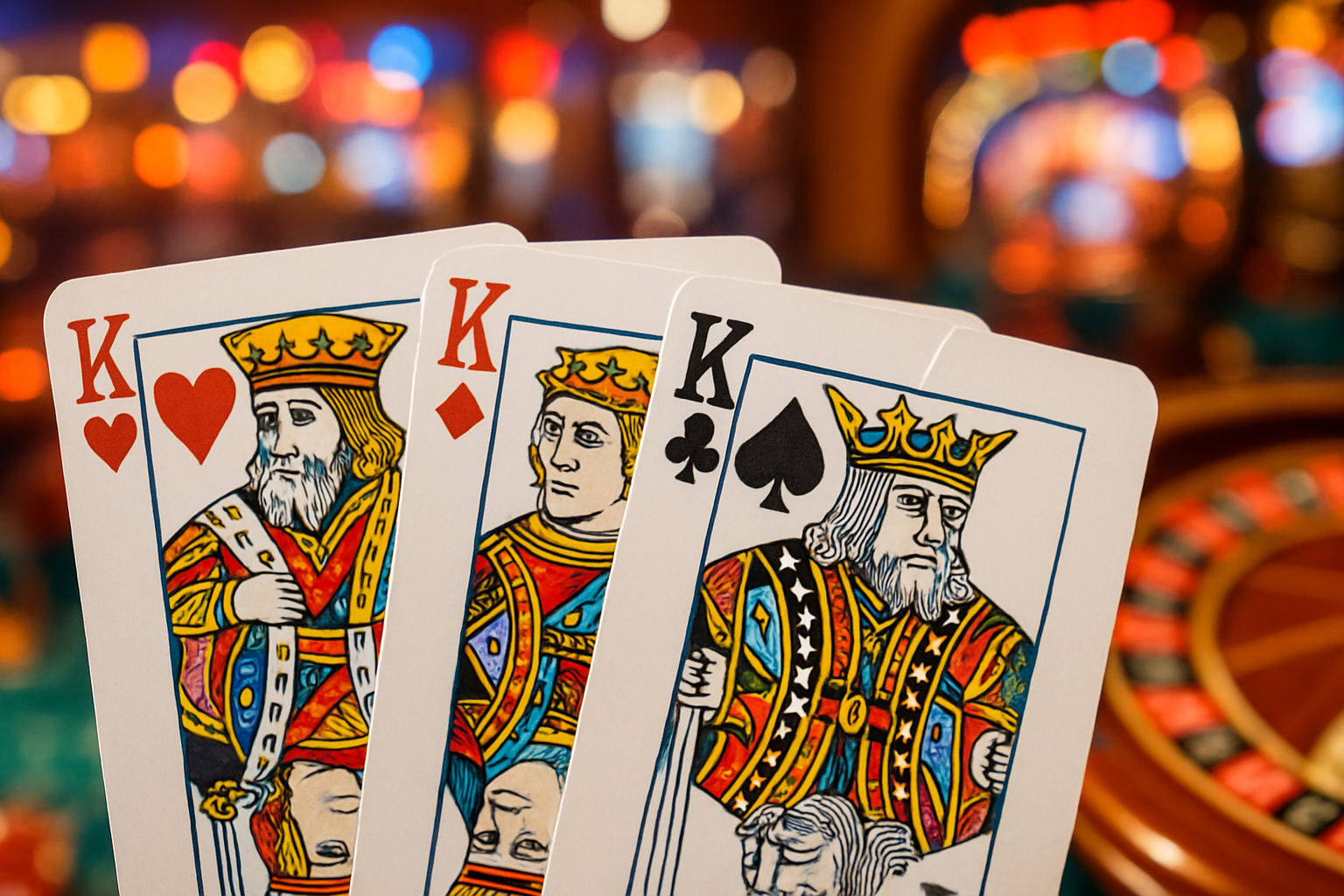
One of the best-known traditions in card symbolism casino culture is the naming of the four kings after famous rulers or military leaders. In a widely repeated French tradition, the King of Hearts is linked with Charlemagne, the King of Diamonds with Julius Caesar, the King of Clubs with Alexander the Great and the King of Spades with the biblical King David.
These assignments are appealing because they connect familiar card images with major figures from European and classical history. Charlemagne evokes medieval kingship; Caesar represents Roman authority; Alexander suggests conquest and leadership; and David brings the prestige of biblical monarchy. However, the pictures on modern cards should not be treated as verified portraits of these men. Court-card designs were copied, adapted and redrawn repeatedly by printers. The names were applied inconsistently, and not every historical deck followed the same convention.
The King of Hearts is sometimes called the “suicide king” because many modern designs appear to show him holding a weapon behind his head. This is not evidence of a hidden historical story or symbolic act. It is generally understood as the result of design changes over time, as an earlier image of a king holding an axe or sword became simplified and altered through repeated copying.
Queens have their own set of traditional identifications in some French-inspired decks. The Queen of Spades has often been associated with Pallas, or Athena, the classical goddess of wisdom. The Queen of Hearts has been linked with Judith, a biblical heroine. The Queen of Diamonds has been connected with Rachel, a matriarch from the Hebrew Bible, while the Queen of Clubs has sometimes been called Argine, a name often explained as an anagram of regina, the Latin word for queen. Like the kings' names, these links belong to particular historical traditions rather than a universal rule.
The queen's place in the deck also reflects an important difference between card cultures. In many French decks, the queen ranks between king and jack. In some older European patterns, there was no queen at all. Other court figures could appear instead, including a mounted knight or cavalier. Spanish and Italian decks, for example, often use a king, knight and jack-like figure rather than king, queen and jack. This variety shows that the king queen jack meaning depends partly on the region and period in which a deck was made.
The jack has an especially practical social meaning. It was historically called the knave, a term for a young man of lower rank, often a servant or attendant. In English-speaking decks, “jack” gradually replaced “knave” during the nineteenth century. One reason was clarity: the abbreviation for knave, K, could be confused with the king's K in printed indexes. The letter J offered a cleaner distinction.
In visual terms, jacks often carry weapons, staffs or other signs of service and readiness. They may look like guards, pages, messengers or junior noblemen. They are not usually intended to represent one universally agreed historical person. Instead, they express a role within the imagined royal household: below the monarchs, but still more prominent than ordinary numbered cards.
Court Cards in Modern Play
The continued use of face cards in casinos is largely a matter of standardisation and recognition. French-suited decks became dominant in many international card games because they are compact, easy to print and easy to read at a glance. Once a common pattern was established, game rules, manufacturers and players all benefited from using the same ranks and suit structure.
In poker, kings, queens and jacks are high-ranking cards that contribute to pairs, three of a kind, straights and other hand combinations. Their historical imagery has no effect on the mathematical value of a hand, but their distinctive faces make them immediately recognisable. A pair of kings and a pair of jacks may have different rankings under poker rules, yet the images themselves carry no special power beyond the rules of the game.
In blackjack, face cards are especially simple: kings, queens and jacks each count as ten. Their shared value is a rule of the game, not a statement that one court figure is historically equal to another. The visual distinction remains useful, as players can quickly identify a ten-value card while still seeing the familiar court artwork.
Baccarat uses the same court cards in a different way. Kings, queens and jacks count as zero, as do tens. Again, the meaning is entirely game-specific. The same illustrated figure can be high in poker, worth ten in blackjack and worth zero in baccarat. This contrast is a useful reminder that card symbolism and game mechanics are separate things.
For Belgian players, the deck can feel both international and local. Belgium has a strong tradition of printing, illustration and card play, while casinos and home games commonly use the French suit system. Hearts, diamonds, clubs and spades are understood across borders, which helps explain why these figures work so well in games played by people from many different countries.
The enduring appeal of court cards also comes from their visual balance. They bring personality to a deck without requiring a player to know a detailed story. A crowned ruler, an elegant queen and a youthful attendant are instantly readable archetypes. Over time, they have become part of a shared visual vocabulary used in games, advertising, art and popular culture.
It is worth approaching these images as cultural artefacts rather than secret codes. Theories about named kings and queens can add historical colour, but they should not be confused with proven biographies or predictions. The real legacy of the court cards lies in their adaptability: medieval social roles were transformed into standardised images that still fit the practical needs of modern card games.
✅ Conclusion
The face cards in a classic deck are small pieces of living history. Their crowns, robes and weapons preserve echoes of European courts, while their standardised forms reflect centuries of trade, printing and game design. Whether a king is associated with Charlemagne or Caesar, or a queen with a classical or biblical figure, these names are best viewed as traditions layered onto evolving artwork. Today, the figures remain universal not because of mystery, but because a shared deck design makes card games easy to understand across cultures.
Want to go deeper? Read our full how to play blackjack guide. Browse our independent Belgian casino reviews to find a trusted, licensed place to play. Casino Brussel only lists Belgian online casinos licensed by the Belgian Gaming Commission, the country’s official gambling regulator.Historical knowledge can make card games more enjoyable, but it does not change the odds or predict results. Casino games should be treated as paid entertainment, not as a way to make money. Set a budget before playing, avoid chasing losses and take breaks when the activity stops feeling enjoyable. If gambling is causing stress or financial difficulty, seek support from a trusted professional or a recognised support service in Belgium.
If gambling stops being fun, free and confidential support is available at stopoptijd.be.Ready to Play at a Licensed Casino?
Discover our BGC-licensed Belgian casinos — safe, regulated and trusted.
See Casino Reviews ?